
Every streaming service has that one title buried so deep in its catalogue that finding it feels less like browsing and more like an archaeological dig. Netflix’s Mosul is one of those films.
Released in 2020 and produced by the Russo Brothers—the same duo behind a small indie project called Avengers: Endgame—Mosul arrived with little fanfare and disappeared almost immediately beneath the endless avalanche of true-crime documentaries, dating shows, and prestige dramas. Which is a shame, because it may be one of the finest war films of the past decade.
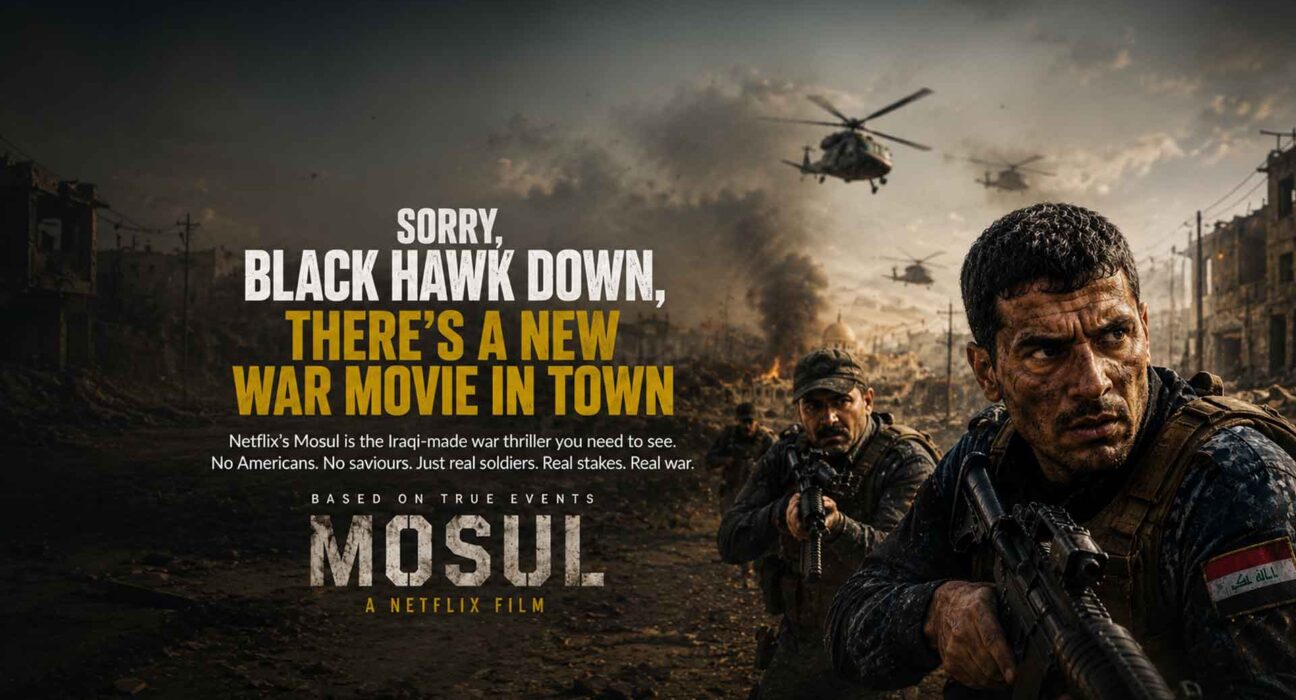
Based on true events, Mosul follows an elite Iraqi police unit fighting ISIS during the battle to retake Iraq’s second-largest city. The film does something Hollywood war movies rarely attempt: it tells the story entirely from the perspective of those who actually lived through it. No American soldiers. No foreign journalists. No Western saviours parachuting in to explain what’s happening.
Just Iraqis fighting for their city, their families, and their survival.
The result is a film that feels startlingly authentic. The action sequences are chaotic without becoming incomprehensible, tense without relying on cheap tricks, and brutal without descending into spectacle. Unlike many modern war films, Mosul isn’t interested in turning combat into a video game. Every firefight carries weight because every loss matters.
Which brings us to Black Hawk Down.
Ridley Scott’s 2001 classic remains one of the most influential war films ever made. Its impact can still be seen in everything from Generation Kill to Call of Duty. But watching Mosul today is a reminder of how much the genre has evolved. Where Black Hawk Down viewed conflict largely through an American lens, Mosul offers something rarer: a war story told by the people whose lives are permanently shaped by it.
It’s not necessarily bigger than Black Hawk Down. It certainly isn’t more famous. But it is more intimate, more immediate, and in many ways more emotionally resonant.
Perhaps the most remarkable thing about Mosul is that it trusts its audience. There are no lengthy explanations, no clunky exposition, and no attempts to simplify a complex conflict into easy heroes and villains. The film throws viewers into the middle of the action and expects them to keep up.
Imagine that: a streaming film assuming we’re paying attention.
In an era when every platform is fighting for eyeballs with louder explosions, bigger budgets, and increasingly absurd plot twists, Mosul stands out by doing something radical—it tells a compelling story extraordinarily well.
So if you’ve spent the last six months scrolling through Netflix muttering, “There’s nothing to watch,” consider this your assignment.
Mosul isn’t just one of Netflix’s hidden gems. It’s proof that some of the best films on streaming are the ones the algorithm forgot.