
In May 1980, a hostage crisis in the heart of London ended with one of the most dramatic special forces operations ever broadcast on television. The Iranian Embassy siege lasted six days, cost two hostages their lives and brought Britain’s secretive SAS into the public eye.
The Classic Post | History & The War Archive
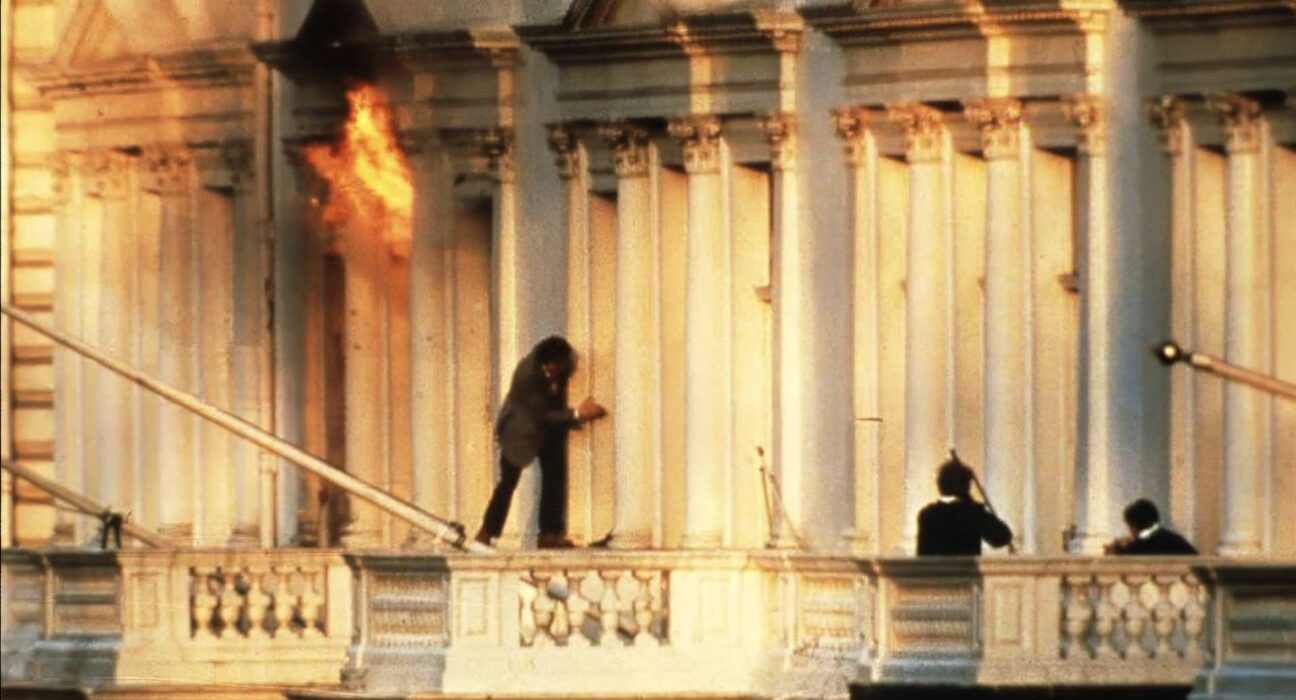
On the afternoon of Monday, 5 May 1980, millions of television viewers watched an extraordinary scene unfold in central London. Black-clad soldiers, wearing gas masks and carrying submachine guns, were abseiling down the front of the Iranian Embassy in Prince’s Gate, smashing windows and forcing their way into the building.
For most of the British public, it was their first real glimpse of the Special Air Service, better known as the SAS.
Until that afternoon, the regiment had operated largely outside public view. Its reputation had been built through decades of military operations, but few people knew much about its methods or capabilities.
That changed in a matter of minutes.
The assault, codenamed Operation Nimrod, brought an end to a six-day siege that had begun with six armed men entering the embassy and taking 26 people hostage.
It would become one of the defining moments in the history of British counter-terrorism.
A Siege Begins in South Kensington
The crisis began shortly before midday on Wednesday, 30 April 1980.
Six armed men belonging to the Democratic Revolutionary Front for the Liberation of Arabistan entered the Iranian Embassy at 16 Prince’s Gate, close to Hyde Park in London.
The group was seeking independence or autonomy for the predominantly Arab region of Khuzestan in southwestern Iran, which they called Arabistan.
The gunmen took 26 hostages, including embassy staff, visitors and a British police constable, Trevor Lock, who had been on duty inside the building.
Their principal demand was the release of Arab prisoners held by the Iranian government. They also wanted safe passage out of Britain.
The timing was particularly sensitive.
Iran had undergone a revolution the previous year, overthrowing the Shah and establishing an Islamic Republic under Ayatollah Khomeini. Political tensions were high, both within Iran and across the Middle East.
The siege in London immediately became an international incident.
Within minutes, armed police surrounded the building. Roads were closed, journalists arrived and negotiators began the difficult task of establishing contact with the gunmen.
What had started as an armed occupation of a diplomatic building was rapidly becoming a test of the British government’s response to terrorism.
The Police Try to Negotiate
For the first several days, the Metropolitan Police attempted to bring the siege to a peaceful conclusion.
Negotiators maintained contact with the hostage-takers, trying to secure the release of captives while preventing the situation from escalating.
Several hostages were released during the negotiations, but the central demands remained unresolved.
Inside the embassy, conditions were becoming increasingly difficult.
The hostages were confined for long periods under armed guard, uncertain whether they would be released or killed.
Among them was Police Constable Trevor Lock, who had entered the building carrying his concealed police revolver. Remarkably, he managed to keep the weapon hidden throughout the siege.
His composure would later prove important during the final assault.
Outside, the police faced a delicate problem. Any attempt to force entry could provoke the gunmen into killing hostages, yet allowing the siege to continue indefinitely carried its own dangers.
Meanwhile, another operation was taking place away from the television cameras.
The SAS was preparing to intervene.
The SAS Moves into Position
By 1980, the SAS had already developed specialist counter-terrorist capabilities in response to the growing threat of international terrorism during the 1970s.
Its soldiers trained for hostage rescue, close-quarter combat and assaults on buildings and aircraft.
The Iranian Embassy presented a particularly difficult challenge.
The building was a substantial Victorian townhouse with several floors, numerous rooms, narrow staircases and adjoining properties. Hostages and gunmen could be anywhere inside.
Any rescue operation would need to be fast, carefully coordinated and sufficiently overwhelming to prevent the terrorists from executing their captives.
Members of the SAS established themselves nearby, studying the building and preparing possible entry routes.
They rehearsed the assault and developed plans to attack from several directions simultaneously.
The intention was to enter the embassy, locate the gunmen and rescue as many hostages as possible before the terrorists could react.
But the final decision to use military force would depend on events inside the building.
For several days, the soldiers waited.
The Sixth Day: Negotiations Collapse
On Monday, 5 May, the situation deteriorated dramatically.
The gunmen became increasingly frustrated by the lack of progress towards their demands.
During the afternoon, they murdered Abbas Lavasani, the embassy’s Iranian press attaché, and threw his body outside the building.
It was the turning point.
The killing demonstrated that the terrorists were prepared to carry out their threats, and there was an immediate fear that more hostages would be murdered.
Prime Minister Margaret Thatcher’s government authorised military intervention, and responsibility for resolving the siege passed to the SAS.
The operation was given the go-ahead.
After six days of negotiations, the crisis was about to end through force.
Operation Nimrod
At approximately 7.23 pm, SAS assault teams began their attack.
The operation was designed to overwhelm the gunmen by entering the embassy from multiple points almost simultaneously.
Soldiers descended on ropes from the roof, while others approached through adjoining buildings and ground-level entrances.
Explosive charges were used to break through windows and doors, and stun grenades helped disorientate those inside.
One of the most memorable images of the operation showed SAS soldiers hanging from ropes against the embassy’s exterior, their black uniforms and gas masks creating a striking and unfamiliar sight.
The assault was not without difficulties.
One soldier became entangled in his rope while descending the building, and a fire broke out during the operation.
Inside, the soldiers moved rapidly through the rooms, searching for the terrorists and securing the hostages.
The fighting was intense but brief.
Five of the six gunmen were killed. The sixth survived and was arrested.
Nineteen hostages were rescued alive during the assault.
Tragically, another hostage, Ali Akbar Samadzadeh, was killed by the terrorists as the operation began.
Together with Abbas Lavasani, who had been murdered earlier that afternoon, he was one of two hostages who lost their lives during the siege.
The assault itself lasted approximately seventeen minutes.
Six days of tension had ended in less time than an ordinary television news bulletin.
The Policeman Who Kept His Gun Hidden
One of the remarkable personal stories to emerge from the siege concerned Police Constable Trevor Lock.
Lock had been guarding the embassy when the terrorists entered. Despite being taken hostage, he managed to conceal his revolver throughout the six days.
During the SAS assault, he confronted the surviving gunman, Salim, and helped prevent him from escaping or threatening other hostages.
Lock’s actions were widely praised, and he was subsequently awarded the George Medal for his courage.
His experience was a reminder that, while the SAS assault dominated the television coverage, the outcome also depended on the actions of individuals who had endured the siege from inside.
For the hostages, those six days had been an ordeal of uncertainty, fear and confinement.
Their survival was never guaranteed.
The Assault That Britain Watched on Television
The Iranian Embassy siege took place at a time when television news was becoming increasingly capable of bringing major events into people’s homes as they happened.
Cameras had been positioned around Prince’s Gate throughout the crisis.
When the SAS launched its assault, television crews were able to capture extraordinary footage of the soldiers entering the building.
The BBC interrupted its coverage of the World Snooker Championship final to report the dramatic developments.
For viewers, the images were astonishing.
This was not a military operation taking place on a distant battlefield. It was happening in an elegant residential street in London, only a short distance from some of the capital’s most familiar landmarks.
The soldiers appeared almost anonymous behind their gas masks, moving with a speed and purpose that few members of the public had witnessed before.
The footage was replayed around the world.
Almost overnight, the SAS became one of the most recognisable special forces units in existence.
The regiment’s distinctive black assault equipment and its role in hostage rescue entered popular culture.
Yet the sudden publicity presented a contradiction.
The SAS had built much of its effectiveness around secrecy. Now one of its most important operations had been witnessed by millions.
Why the Siege Changed British Counter-Terrorism
Operation Nimrod was widely regarded as a successful hostage rescue, but its importance extended beyond the immediate outcome.
It demonstrated that Britain possessed a specialist military capability able to respond to a major terrorist incident on home soil.
The operation also highlighted the importance of cooperation between the police, government and armed forces.
For six days, the police had attempted to negotiate a peaceful settlement. Military intervention came only after the murder of a hostage and the collapse of hopes for a negotiated resolution.
The siege established a highly visible precedent for the use of specialist military forces in extreme hostage situations.
It also raised difficult questions about the risks involved in armed intervention, the protection of hostages and the circumstances in which lethal force could be justified.
Those questions remain relevant today.
The surviving gunman was later convicted and sentenced to life imprisonment. He was released in 2008 after serving approximately 27 years.
The embassy itself was severely damaged during the assault and the resulting fire, and required extensive repairs.
But the lasting legacy of the siege was not the damage to a building.
It was the way the events of those six days altered public understanding of terrorism, hostage rescue and the capabilities of Britain’s special forces.
Six Days That Changed the SAS
More than four decades later, the Iranian Embassy siege remains one of the most famous counter-terrorist operations in British history.
The television images are still instantly recognisable: soldiers descending ropes, windows breaking, smoke pouring from the building and frightened hostages being hurried to safety.
But behind those images was a far more complicated story.
There were six days of negotiations, difficult decisions taken under enormous pressure, the courage of hostages and police officers, and the careful preparations of soldiers who knew that a mistake could cost innocent lives.
Operation Nimrod brought the siege to an end and made the SAS famous around the world.
For the hostages and their families, however, it was something much more personal.
It was the end of six days in which nobody could be certain who would survive.
And for two of them, rescue came too late.
Watch The Iranian Embassy Siege on RODtv
The Iranian Embassy Siege: Six Days That Changed the SAS revisits the events of April and May 1980, from the first moments of the hostage crisis to the dramatic SAS assault that brought it to an end.
Discover the background to the siege, the decisions that shaped the response and the operation that transformed the public image of Britain’s most famous special forces regiment.