

Last week, Clarkson’s Farm did something few streaming shows ever achieve.
It got people talking about their health.Not the weather. Not politics. Not celebrity gossip. Not even farming. Health.
The latest episodes of Amazon’s unlikely hit series revealed Jeremy Clarkson’s health scare, showing viewers a side of Britain’s most outspoken television personality that rarely makes it on screen. Gone was the swaggering presenter who spent decades driving supercars sideways, picking fights with politicians, and treating medical advice as little more than a polite suggestion. Instead, viewers saw something far more relatable.
A man confronting the reality that none of us are indestructible.The response was immediate. Social media filled with conversations about check-ups, screenings, family history, and the importance of taking symptoms seriously. Healthcare professionals reported increased public interest in preventative health measures, while countless viewers shared stories of booking appointments they had been putting off for months—or even years. It wasn’t the storyline anyone expected from a programme about farming.Yet it became one of the most significant moments in recent streaming television.
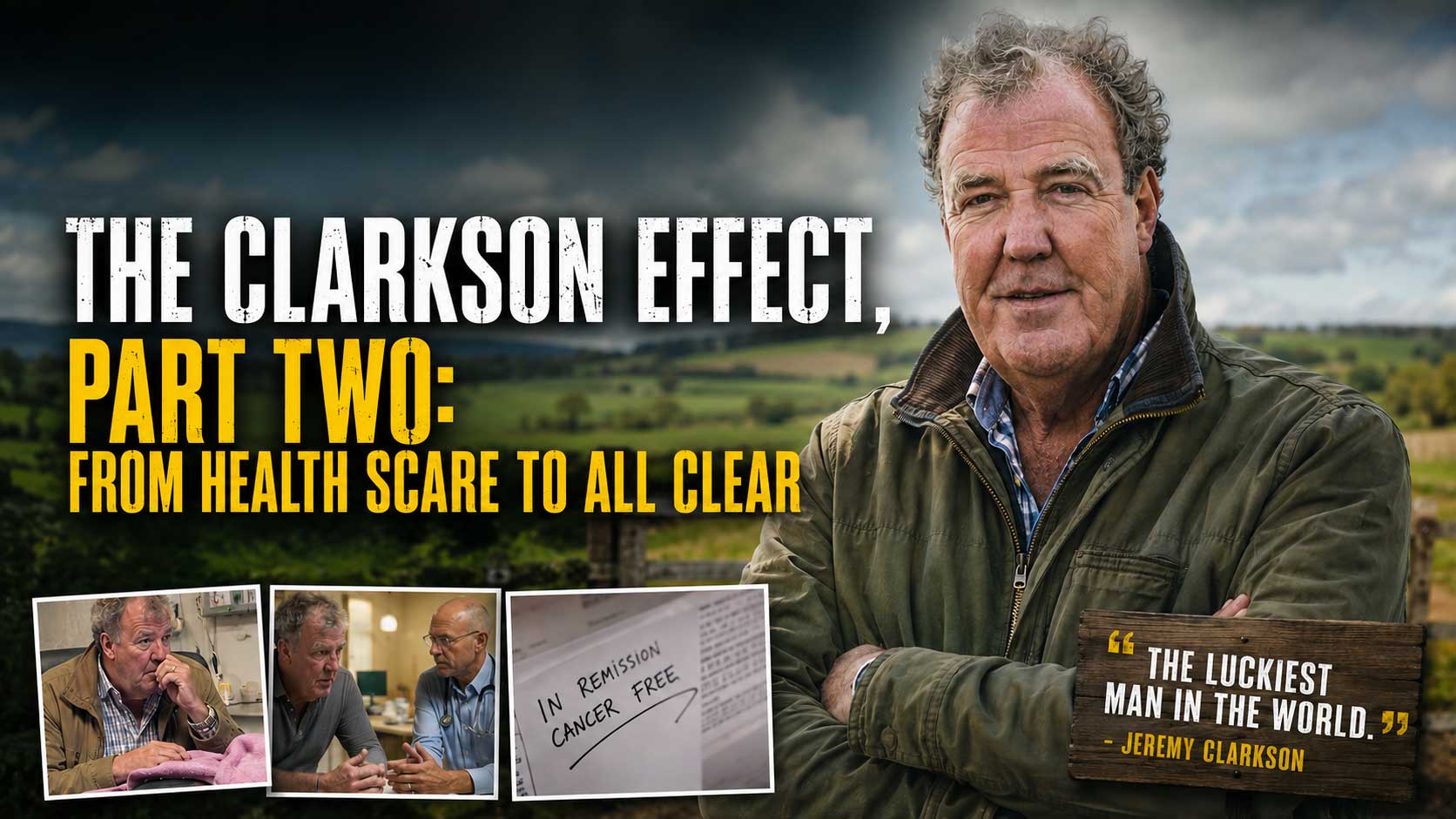
Now comes the update everyone has been hoping for. Since the series was filmed, Clarkson has undergone treatment and has revealed that he is now in remission and cancer-free. Reflecting on his experience, he has described himself as “the luckiest man in the world.”
For viewers who spent recent episodes watching events unfold, the news comes as a huge relief. It also changes the way many people will look back on those episodes.
At the time, audiences were watching a story filled with uncertainty. Like Clarkson himself, viewers didn’t know what would happen next. Every conversation, every doctor’s appointment, and every moment of concern carried genuine emotional weight because the outcome remained unknown. Now, with the benefit of hindsight, those same scenes feel very different. They have become part of a story with a positive ending.
And in today’s television landscape, that’s rarer than you might think. Streaming platforms are filled with dystopian futures, serial killers, corporate scandals, true-crime mysteries, and documentaries designed to leave audiences feeling anxious about the state of the world.
Clarkson’s Farm has always been different.
Its appeal has never really been about farming. Not entirely. The tractors, livestock, crops, weather disasters, planning disputes, and endless machinery breakdowns are entertaining enough. But the real success of the show comes from its ability to find humanity in everyday life. Viewers don’t tune in simply to learn about sheep. They tune in because they care about the people.
Over four seasons, audiences have developed a genuine affection for the show’s cast. Kaleb Cooper, Lisa Hogan, Charlie Ireland, Gerald Cooper and Clarkson himself have become some of streaming’s most beloved personalities. They feel real. And that authenticity is precisely why the health storyline resonated so strongly.
Unlike carefully managed celebrity interviews or public-relations campaigns, Clarkson’s Farm presents life as it happens—messy, unpredictable and occasionally frightening. The health scare wasn’t presented as a dramatic television plot twist. It was presented as reality. Perhaps that’s why viewers connected with it.
Most of us know someone who has delayed making an appointment. Most of us have ignored symptoms, postponed tests, or convinced ourselves that everything is probably fine. Health concerns have a way of feeling distant—until they suddenly aren’t.
Clarkson’s experience served as a reminder that early intervention matters. And judging by the reaction, people listened.
It’s not often that a streaming programme influences behaviour in the real world, but Clarkson’s Farm appears to have done exactly that. The irony, of course, is that Jeremy Clarkson may be the last person anyone expected to become an advocate for preventative healthcare.
This is a man who built an entire career around appearing fearless. Yet that may be exactly why his story carried such impact. If it can happen to Clarkson, viewers reasoned, it can happen to anyone. Fortunately, the latest chapter brings welcome news.
The treatment has been successful. The uncertainty has lifted. And Clarkson can now look ahead to the future. Season Six is already in production The show’s fans will undoubtedly be doing the same.
Because while Clarkson’s Farm remains one of the funniest and most entertaining series on streaming, its latest season delivered something even more valuable: perspective. Amid the jokes, the farming disasters, the arguments and the chaos, it reminded viewers that health is never something to take for granted.
That’s not the sort of lesson most people expect from a television programme.
Then again, few people expected a farming show to become one of the biggest streaming successes of the decade.
Or for Jeremy Clarkson to spark a national conversation about health.
Or for one candid television moment to encourage thousands of people to book a check-up.
Sometimes the most powerful stories aren’t the ones writers create.
They’re the ones that happen in real life.
And for Jeremy Clarkson, this particular story has delivered the ending everyone wanted to hear.
Cancer-free. In remission. And, in his own words, the luckiest man in the world.