


In April 1970, three astronauts set out for the Moon. Two days later, an explosion turned their mission into one of the most extraordinary rescue operations in the history of space exploration.
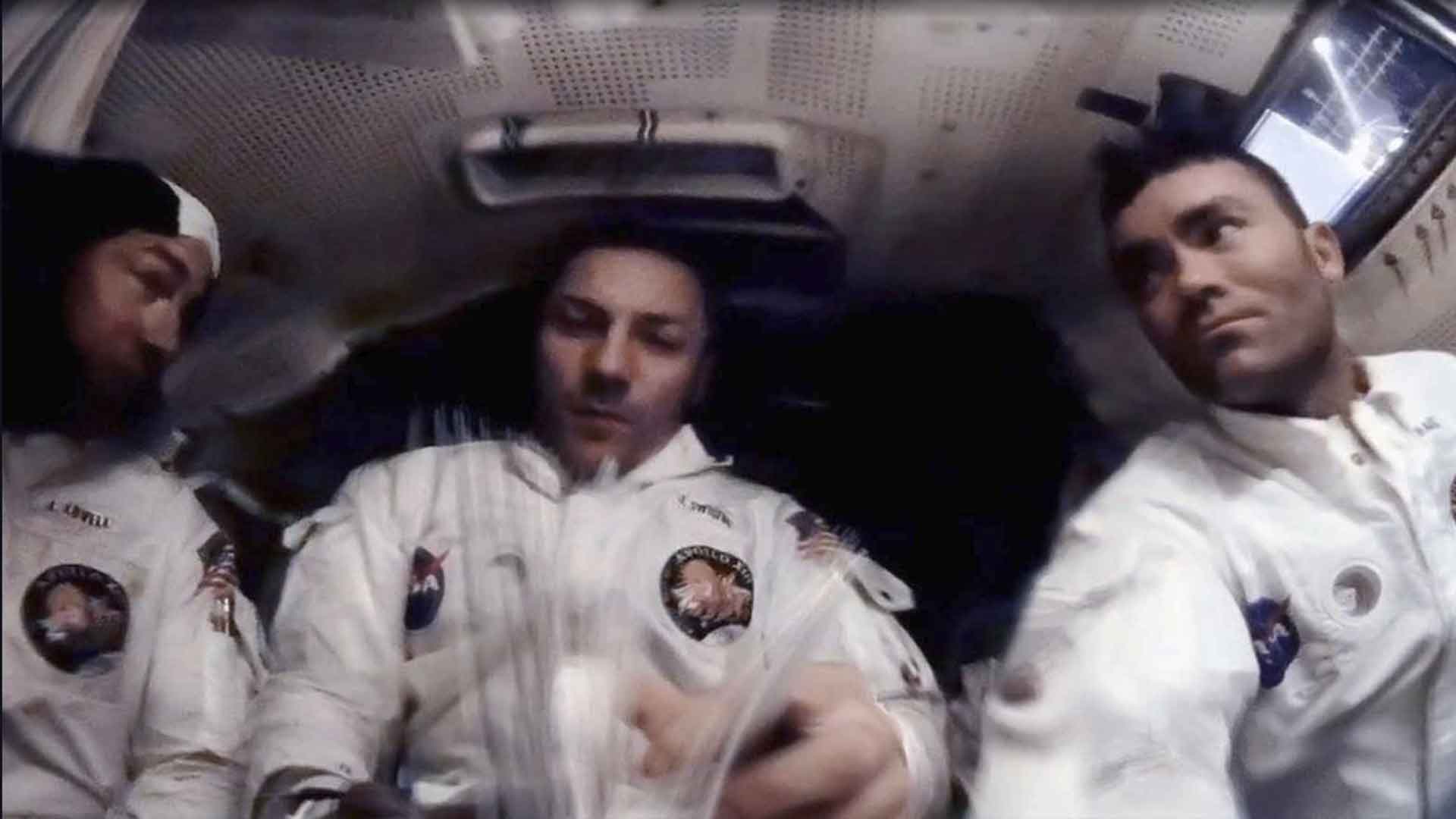
On 11 April 1970, Apollo 13 lifted off from Kennedy Space Center in Florida. On board were Commander Jim Lovell, Command Module Pilot Jack Swigert and Lunar Module Pilot Fred Haise. Their destination was the Moon, where Lovell and Haise were due to explore the Fra Mauro highlands.
It was to be NASA’s third attempt to land astronauts on the lunar surface. After the historic achievements of Apollo 11 and Apollo 12, another successful landing was beginning to seem almost routine.
Apollo 13 would change that perception completely.
Houston, We’ve Had a Problem
For the first two days, the flight appeared to be progressing normally. The spacecraft was more than 200,000 miles from Earth when, on the evening of 13 April, the crew heard a loud bang.
An oxygen tank in the Service Module had exploded.
Within minutes, the astronauts were dealing with a rapidly deteriorating spacecraft. Oxygen was escaping into space, electrical power was failing, and the systems that supported life inside the Command Module were in danger of shutting down.
Jack Swigert reported the first warning to Mission Control. Jim Lovell then confirmed the seriousness of the situation with the words that would become part of spaceflight history:
“Houston, we’ve had a problem.”
The Moon landing was immediately abandoned.
The challenge was no longer to reach the lunar surface. It was to bring three men home alive.
A Lifeboat in Space
The Command Module, Odyssey, had been designed to carry the astronauts to the Moon and return them safely to Earth. Now its remaining resources had to be conserved for re-entry.
The crew moved into the Lunar Module, Aquarius, which had originally been intended to carry just two astronauts down to the lunar surface.
It became their emergency lifeboat.
There was one considerable problem. Aquarius had not been designed to keep three men alive for the journey back to Earth.
Power was limited, water was scarce, and temperatures inside the spacecraft began to fall. The astronauts were cold, exhausted and facing an uncertain return.
Meanwhile, engineers at Mission Control in Houston worked around the clock to find solutions to problems nobody had expected to encounter.
One of the most remarkable involved the spacecraft’s carbon dioxide removal system. The Lunar Module’s filters were becoming saturated, while spare filters from the Command Module were a different shape and could not be fitted directly.
Using materials available aboard the spacecraft, including plastic bags, cardboard and tape, NASA engineers devised an improvised adaptor.
The crew assembled it in space, following instructions from the ground.
It worked.
Around the Moon — But Never Landing
Apollo 13 continued towards the Moon, using its gravity to help carry the damaged spacecraft back towards Earth.
For Jim Lovell, who had previously flown around the Moon aboard Apollo 8, it was another journey past a world he would never get to explore on foot.
Fred Haise, who had trained for years to walk on the lunar surface, watched his opportunity disappear.
Yet there was little time for disappointment. Every available resource was being devoted to survival.
The crew had to perform critical engine burns, manage their dwindling power supplies and prepare the Command Module for re-entry after days of being largely shut down.
It was an extraordinary exercise in cooperation between the astronauts and hundreds of specialists on the ground.
The Long Journey Home
On 17 April, six days after launch, Apollo 13 approached Earth.
The damaged Service Module was jettisoned, revealing the extent of the explosion. The crew then separated from the Lunar Module that had kept them alive.
For the final descent, they were once again inside Odyssey.
As the spacecraft entered Earth’s atmosphere, radio communication was lost during the expected blackout period. Mission Control waited anxiously for confirmation that the astronauts had survived re-entry.
Then the parachutes appeared.
Apollo 13 splashed down safely in the Pacific Ocean, and all three astronauts were recovered.
A mission that had come perilously close to disaster ended with one of NASA’s most celebrated recoveries.
A Successful Failure
Apollo 13 never achieved its original objective. No astronaut walked on the Moon, and the planned scientific experiments were abandoned.
Yet the mission demonstrated something equally significant: the ability of people working thousands of miles apart to solve seemingly impossible problems under extraordinary pressure.
The astronauts’ composure, the ingenuity of Mission Control and the determination of the entire NASA team transformed a potentially fatal accident into a remarkable survival story.
The mission subsequently became known as NASA’s successful failure.
More than half a century later, Apollo 13 remains a powerful reminder that space exploration has never been routine, however familiar the images of rockets and astronauts may have become.
Watch Apollo 13 on RODtv
The documentary Apollo 13, available on RODtv, revisits the dramatic mission that captivated the world in April 1970.
From the initial explosion to the extraordinary efforts to keep three astronauts alive, it tells the story of a journey to the Moon that became a race to return to Earth.
Watch Apollo 13 on RODtv as part of The Weekly Edition and explore more space documentaries in the RODtv collection.