

Snow-covered mountains, frozen rivers, a little railway luxury and an unexpected visit from Santa Claus. Natalie R travels from Vancouver through the Canadian Rockies to Banff, discovering why winter might just be the most beautiful time to see western Canada.
By Natalie R. | Travel & Experiences | The Classic Post
There are few better places to begin a railway adventure than Vancouver. The Pacific Ocean lies to the west, mountains rise above the city to the north, and beyond them stretches some of the most spectacular wilderness in North America.
At Christmas, the prospect becomes even more appealing. The mountains are covered in snow, the forests have taken on their winter colors, and the Canadian Rockies look as though somebody has been rather generous with the icing sugar.
Our journey takes us aboard the Rocky Mountaineer, leaving Vancouver and heading east through British Columbia, past Revelstoke and Field, before arriving in Banff, one of Canada’s most celebrated mountain resorts.
It’s a journey of extraordinary scenery, comfortable railway travel and a few surprises along the way. Including, as it turns out, a special stop for Father Christmas.
And really, if you’re going to meet Santa anywhere, a snow-covered railway in the Canadian mountains seems as good a place as any.
Leaving Vancouver Behind
Vancouver is one of those cities where you can spend the morning beside the ocean and the afternoon looking at snow-covered mountains. It’s an impressive arrangement, and one that makes leaving slightly difficult.
But the scenery beyond the city is even more remarkable.
As our train heads inland, the urban landscape gradually gives way to wooded hillsides, river valleys and the vast interior of British Columbia.
The Rocky Mountaineer has earned an international reputation for its luxury rail journeys, and it’s easy to understand the appeal. Large panoramic windows bring the landscape into the carriage, while comfortable seating and attentive service make the journey feel like an occasion in its own right.
There’s something wonderfully civilized about watching the Canadian wilderness unfold while somebody else takes care of the driving.
Particularly in winter.
Outside, the temperature is falling, snow covers the higher ground, and the mountains begin to dominate the horizon. Inside, passengers can settle back and enjoy the view without worrying about icy roads, snow chains or whether they’ve packed enough thermal underwear.
It’s a very agreeable way to travel.
Into the Heart of British Columbia
The further we travel from Vancouver, the more dramatic the scenery becomes.
The railway follows valleys carved through the mountains, passing forests of evergreen trees, rivers and remote stretches of countryside where human activity seems almost incidental.
Canada has a remarkable ability to make distances feel enormous. A mountain that appears close enough to touch may still be miles away, while the forests seem to continue indefinitely.
In winter, the effect is even more striking.
Snow settles along the railway and gathers on the branches of the trees. Rivers wind between white banks, and the surrounding peaks disappear into low cloud before emerging again in the sunlight.
Every bend in the track seems to offer another view worth photographing.
Of course, the difficulty with taking photographs from a train is knowing when to stop. Eventually, you realize that the scenery isn’t going to run out, and it’s perfectly acceptable simply to sit and enjoy it.
That’s when railway travel really comes into its own.
Revelstoke: A Town Built Around the Mountains
As we continue east, we reach the region around Revelstoke, a mountain town with a long association with Canada’s railway history.
Situated beside the Columbia River and surrounded by the Selkirk and Monashee Mountains, Revelstoke developed as an important point on the Canadian Pacific Railway.
The railway helped open up this remote part of British Columbia, connecting communities and providing a route through terrain that had once presented enormous challenges to travelers and engineers alike.
Today, Revelstoke is also known as a winter sports destination, attracting skiers and snowboarders to its impressive mountain terrain.
At Christmas, the surrounding landscape is particularly beautiful. Snow-covered forests climb the hillsides, while the mountains rise steeply above the valley.
It’s the sort of place that makes you wonder whether living in a mountain town might be rather appealing.
At least until you remember that somebody has to clear the driveway.
For visitors, however, the attraction is obvious. Revelstoke combines the atmosphere of a traditional railway town with some of western Canada’s most impressive winter scenery.
And for passengers continuing towards the Rockies, the mountains are only getting bigger.
A Christmas Surprise Along the Railway
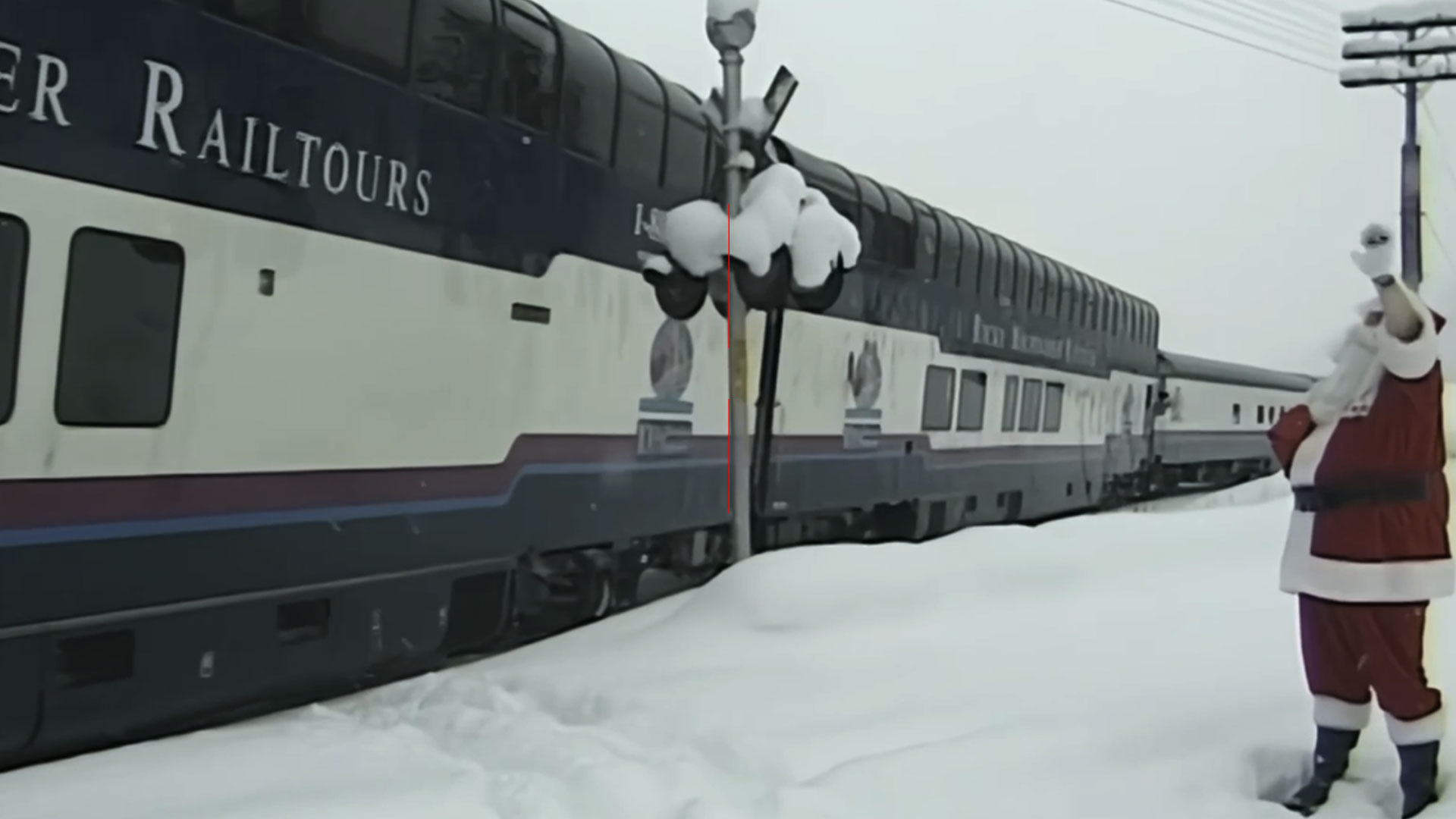
Every good Christmas journey deserves a surprise, and ours arrives in the form of a rather familiar gentleman dressed in red.
The train makes a special stop for Father Christmas.
It’s a wonderfully cheerful moment, and one that seems entirely appropriate to the surroundings.
After all, we’re traveling through a landscape of snow-covered trees and frozen mountain scenery. If Santa Claus were to appear beside a railway anywhere outside the North Pole, this would be a perfectly reasonable location.
There’s something about Christmas that allows even the most sophisticated adults to suspend their disbelief for a little while.
The appearance of Father Christmas brings a touch of festive fun to a journey already filled with memorable sights.
And while the mountains may provide the spectacular scenery, it’s often these unexpected moments that people remember long after a holiday has ended.
A luxury train, a Canadian winter and a visit from Santa.
You could certainly arrange a less enjoyable Christmas outing.
Field: A Small Village in an Enormous Landscape
Continuing east, our journey brings us towards Field, a small community in British Columbia’s Yoho National Park.
Field is one of those places that demonstrates just how little space a village needs when the surrounding mountains are doing most of the work.
Set in the Kicking Horse River valley, it is surrounded by towering peaks and some of the most impressive scenery in the Canadian Rockies.
The village has a strong railway heritage, having developed alongside the Canadian Pacific Railway during the construction of the transcontinental route.
Nearby is one of Canada’s great railway engineering achievements: the Spiral Tunnels.
Built to overcome the difficulties of the steep Kicking Horse Pass, the tunnels allow trains to gain or lose elevation by following a longer, looping route through the mountains.
It’s a remarkable piece of engineering, particularly when you consider the challenges faced by the people who built it more than a century ago.
But for travelers, Field’s greatest attraction is undoubtedly its setting.
The mountains rise almost directly from the valley floor, their slopes covered in forests and snow. The scale is extraordinary, and the village seems tiny beneath the surrounding peaks.
In summer, Yoho National Park is famous for its hiking trails, waterfalls and beautiful mountain lakes.
In winter, the landscape takes on a quieter character. Snow softens the contours of the mountains, and the forests appear almost motionless beneath their white covering.
It’s a place that deserves to be seen slowly.
Fortunately, that’s exactly what we’re doing.
Crossing into Alberta
From Field, the railway continues east through the mountains towards the border between British Columbia and Alberta.
This is some of the most spectacular country in Canada.
The Continental Divide runs through this region, separating watersheds that eventually drain towards different oceans. It’s a geographical boundary of enormous significance, although from the comfort of a railway carriage, the more immediate attraction is the scenery.
Mountains tower above the track, valleys open unexpectedly between the peaks, and the snow-covered landscape stretches as far as the eye can see.
The Rockies have a grandeur that’s difficult to capture in photographs. Their scale is best appreciated in person, particularly when traveling through them rather than simply viewing them from a distance.
There’s also something rather satisfying about approaching Banff by rail.
Long before the Canadian Rockies became an international tourist destination, the railway played a central role in making the region accessible.
It brought visitors to the mountains, encouraged the development of grand hotels and helped establish Banff as one of Canada’s most famous resorts.
More than a century later, arriving through the mountains remains a wonderful way to experience the landscape.
Banff: Christmas in the Canadian Rockies
Our journey ends in Banff, a town that seems almost perfectly suited to the Christmas season.
Situated within Banff National Park, Canada’s oldest national park, Banff is surrounded by magnificent mountain scenery.
Cascade Mountain rises above the town, while the surrounding peaks provide a dramatic backdrop to its streets, hotels and restaurants.
In winter, Banff becomes one of North America’s most attractive mountain destinations.
Snow covers the surrounding landscape, Christmas lights illuminate the town, and the atmosphere is a delightful mixture of traditional mountain resort and festive holiday destination.
For skiers, the region offers several famous resorts, including Sunshine Village, Lake Louise Ski Resort and Mount Norquay.
But Banff has plenty to offer visitors who prefer to keep both feet firmly on the ground.
There are beautiful walks, mountain viewpoints, shops, restaurants and comfortable hotels where the greatest challenge of the afternoon may be deciding whether to order another hot chocolate.
And frankly, that’s a challenge I’m usually prepared to accept.
One of the pleasures of Banff is that the mountains are never far away. Even a short walk through the town provides extraordinary views.
It’s a place where the scenery is so impressive that ordinary activities somehow become memorable.
A morning coffee with a view of Cascade Mountain is rather different from a morning coffee overlooking a parking lot.
Although, to be fair, the coffee itself may be much the same.
The Magic of a Winter Railway Journey
There are many ways to explore the Canadian Rockies.
You can drive through the mountains, fly over them, hike among them or spend a week skiing down them.
But there’s something particularly appealing about seeing them from a train.
Rail travel encourages a different pace. Instead of concentrating on the road ahead, you can watch the landscape change, appreciate the distances and enjoy the simple pleasure of moving through extraordinary scenery.
And in winter, the contrast between the warmth of the carriage and the frozen world outside makes the experience especially memorable.
The journey from Vancouver through Revelstoke and Field to Banff brings together several of western Canada’s most remarkable landscapes.
It begins beside the Pacific coast, passes through the mountains and forests of British Columbia, and finishes among the great peaks of the Canadian Rockies.
Along the way, there’s railway history, magnificent scenery, the comforts of luxury travel and even a visit from Father Christmas.
Not a bad combination for a Christmas holiday.
For me, the real pleasure of a journey like this is that it never feels as though you’re simply traveling between destinations.
The journey is the destination.
And when the scenery is this good, there’s really no reason to hurry.
Watch the Journey on RODtv
The Rocky Mountaineer: A Christmas Journey Through the Canadian Rockies follows this remarkable railway adventure from Vancouver through Revelstoke and Field to Banff.
Travel through spectacular snow-covered landscapes, discover the beauty of the Canadian mountains in winter and enjoy a special festive stop for Father Christmas.
The film is available on RODtv, featured in The Weekly Edition, alongside more original films, travel adventures and extraordinary experiences.
You can also explore further journeys and destinations in The Bucket List collection on RODtv.